This series approaches each year as a nine-song spread – loosely inspired by a tarot reading – drawn by instinct, arranged for flow, and interpreted only after the sequence reveals its shape. What emerges is not a ranking, but a reflection: a portrait of a year told through tone, tension, and transition.
1968: Cultural & Astrological Snapshot
1968 is a year defined by rupture.
The assassinations of Martin Luther King Jr. and Robert F. Kennedy fracture any remaining sense of forward momentum, unfolding against the backdrop of the Vietnam War and escalating protests at home. Public trust erodes further with the election of Richard Nixon, signaling a shift toward order, control, and political recalibration.
At the same time, culture reflects a widening split. In theaters, Funny Girl offers personal triumph and nostalgia, while 2001: A Space Odyssey looks outward – cold, abstract, and detached – toward an uncertain future.
Astrologically, the United States remains under the volatile alignment of Uranus and Pluto in Virgo, a combination associated with systemic breakdown and forced transformation in everyday life and institutions. Saturn in Aries adds pressure, demanding action but often producing conflict, impatience, and confrontation rather than resolution. Meanwhile, Neptune in Scorpio deepens the psychological atmosphere, blurring the line between awakening and disillusionment.
NOTE: The Full Spread playlist is included at the end of this post. (Listen Before, During or After…or Not at All)
Act I – Control / Containment
1968 doesn’t begin with expansion…it begins with control.
What appears on the surface as preservation, reflection, or connection is actually something tighter: a need to define, contain, and manage experience before it gets out of hand. The tone is not open, it’s guarded. Not expressive, defensive.
Each of these songs, in its own way, attempts to stabilize something that no longer feels stable.
1. “The Village Green Preservation Society” – The Kinks
This is control presented as nostalgia. Everything must be preserved – culture, identity, memory – but the insistence reveals the problem. The more that needs protecting, the more it suggests that loss is already underway.
The tone is polite, almost quaint, but underneath is something rigid. Preservation becomes restriction, and the desire to hold onto the past starts to feel like an attempt to freeze reality in place. It’s not celebration. It’s containment through idealization.
2. “Hazy Shade of Winter” – Simon & Garfunkel
If the first song tries to hold things together, this one acknowledges that it’s not working.
The tone is colder, more insular, and notably self-aware. There’s no illusion of control here, only the recognition that time is passing and nothing is aligning the way it should. But instead of expanding outward, the response is to pull inward. The world narrows. The energy contracts.
This is control through withdrawal.
3. “Hello, I Love You” – The Doors
Here, the interaction is stripped down to appearance and desire. The woman isn’t engaged with…she’s assessed. The language is simple, repetitive, and revealing in its lack of depth.
Rather than confronting uncertainty or complexity, the song reduces everything to a transactional moment of attraction, placing the narrator at the center and flattening everything else around him. It’s not connection. it’s control through simplification.
Closing Observation (Act I) Each approach is different, but the impulse is the same. Control.
Act II – Rejection / Drift / Excuse
Act II rejects Act I, but not in any meaningful way.
The controlled, insular world gives way to something louder, more public, more aggressive. The setting shifts from preservation to the street, from containment to movement. But almost immediately, the rebellion undercuts itself.
4. “Street Fighting Man” – The Rolling Stones
The environment has changed, no more preservation societies, no more quiet withdrawal. Now it’s confrontation, unrest, movement. But the energy doesn’t fully commit.
“What can a poor boy do…”
That line says everything. It presents itself as defiance, but it’s framed as limitation. The rebellion is already hedged, already qualified. The system is being challenged, but from a position that assumes inevitability of failure. It’s not a call to action. It’s a preemptive justification.
5. Born to Be Wild – Steppenwolf
If “Street Fighting Man” questions the structure, this one abandons it entirely. Movement replaces meaning. Freedom becomes the objective, but without any clear direction or purpose. It’s energy without framework.
The song is featured in the film Easy Rider and like that film’s quiet realization – “we blew it” – the freedom being chased here feels like something already slipping away even as it’s being claimed. Without direction, freedom doesn’t resolve anything. It just extends the drift.
6. “Born Under a Bad Sign” – Cream
If Act I tried to control and Act II tried to break free, this is where both collapse into resignation.
“If It wasn’t for bad luck…”
There’s no rebellion left, only explanation. The problem isn’t the system, the choices, or the self. The problem is fate. Everything is externalized and responsibility disappears.
Closing Observation (Act II): Without direction, without accountability, without anything solid to anchor it, the movement collapses into something far less threatening than it first appeared. Not revolution. Just drift followed by excuse.
Act III – Attempted Emergence / Stagnation
Something tries to rise out of Act II, but it doesn’t come up clean. The collapse into excuse leaves behind a need to recover, to reclaim direction, to move forward. But whatever emerges is already carrying the weight of what failed before it.
The tone shifts again…not back to control, not fully into freedom. but into something more uncertain: an attempt to move forward without having actually changed.
7. “Blackbird” – The Beatles
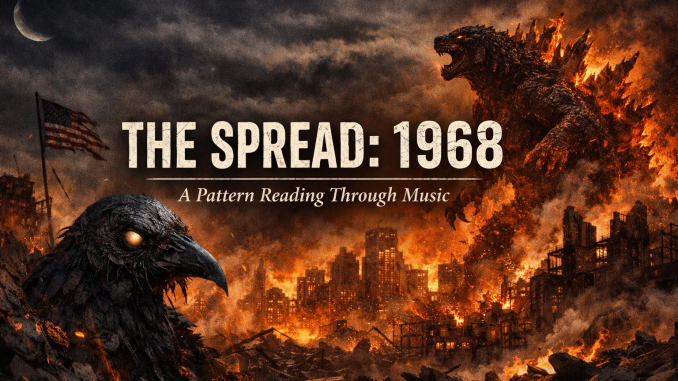
This feels like the moment of renewal. A figure tries to rise…fragile, damaged, but moving.
“Take these broken wings…”
The imagery suggests transformation, something almost phoenix-like. But the environment hasn’t changed.
“Into the light of a dark, black night”
The only space available for this emergence is still darkness. So while the motion is upward, the conditions are not. It’s an attempt at transcendence that never fully escapes its surroundings. Hope appears, but it’s conditional and exposed.
8. “Time of the Season” – The Zombies
If “Blackbird” suggests growth, this immediately complicates it. The tone is smoother, more controlled, more confident…but it feels familiar in the wrong way. The dynamic echoes “Hello, I Love You”, just presented with more polish.
“What’s Your Name? Who’s Your Daddy?”‘
It’s performance again…roles, posture, presentation. Nothing has really been learned. The same patterns return, just dressed more convincingly. This isn’t progress. It’s refinement without change.
9. “Voodoo Child (Slight Return)” – The Jimi Hendrix Experience
If everything else has failed – control, rebellion, reflection – then power steps in to take its place. The presence here is overwhelming, almost mythic. A kind of cultural Godzilla…not subtle, not reflective, just imposing. It’s an attempt to bulldoze meaning into existence, to assert control through sheer force of identity and will.
The year ends not with resolution, but with a kind of sideways exit:
“If I don’t meet you no more in this world, Then I’ll meet you on the next one. Don’t be late”
Final Thought: 1968 doesn’t fail quietly. It insists, it pushes, it reinvents its posture again and again, but beneath all of it, the same tensions remain unresolved. And by the end, the only real conclusion is this: Nothing has been fixed. Only exhausted.



Leave a Reply