
This series approaches each year as a nine-song spread – loosely based on tarot – drawn by instinct, arranged for flow, and interpreted only after the sequence reveals its shape. What emerges is not a ranking, but a reflection: a portrait of a year told through tone, tension, and transition.
1970: Cultural & Astrological Snapshot
1970 opens with a sense of ending rather than escalation.

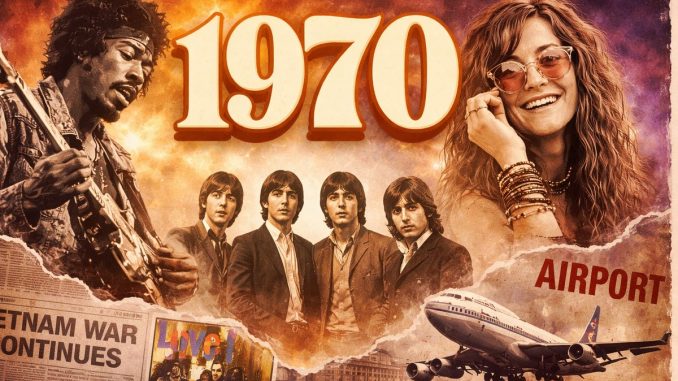
The Vietnam War continues, but the energy around it feels less like confrontation and more like exhaustion. At the same time, the deaths of Jimi Hendrix and Janis Joplin mark the loss of two defining voices of the previous decade, while the breakup of The Beatles removes the era’s most unifying presence altogether. Even popular film reflects this shift. Love Story centers on intimacy and loss, while Airport focuses on containment and survival within a controlled system.
Astrologically, the United States enters a more grounded but uncertain phase. Saturn in Taurus emphasizes limits, stability, and the consequences of prior excess, forcing a confrontation with what can realistically be sustained. Meanwhile, the lingering influence of Uranus and Pluto in Virgo continues to expose weaknesses in systems and institutions, though the energy now feels less explosive and more fatigued and corrective. Neptune in Scorpio deepens the emotional undercurrent, blurring the line between reflection and disillusionment.
NOTE: The Full Spread playlist is included at the end of this post. (Listen Before, During or After…or Not at All)
Act I – Farewell / Acceptance / Departure
1970 doesn’t begin with discovery or collapse. It begins with recognition.
The previous decade isn’t being questioned anymore…it’s over. Whatever it promised, whatever it broke, whatever it revealed has already happened. What remains is the quieter, more difficult task of accepting it and moving on.


1. “Fire and Rain” – James Taylor
This is the most direct acknowledgment of finality.
“Sweet dreams and flying machines / In pieces on the ground”
The imagery says everything. What once felt expansive and possible now lies broken, grounded, finished. There’s no attempt to fix it, no illusion of recovery. Just a quiet confrontation with loss…personal, cultural, and emotional. The tone is calm, but not detached. It understands that something has ended and isn’t coming back. This isn’t reflection. It’s acceptance.
2. “Wild World” – Cat Stevens
If “Fire and Rain” accepts the ending, this song responds to what comes after it. There’s a clear sense of regret, not just for what was lost, but for what can no longer be sustained. The innocence and ease that once felt natural now seem inadequate. The world has changed, or at least the perception of it has. The tone isn’t bitter, but it is protective, almost parental.
“I’ll always remember you like a child”
3. “Big Yellow Taxi” – Joni Mitchell
This is where the tone shifts from reflection to something more active, even if it carries regret with it. The realization is clear: what mattered wasn’t recognized until it was gone. The past is no longer abstract…it’s fixed, altered, paved over.
“They paved paradise and put up a parking lot”
There’s no undoing it. But unlike the previous songs, this one doesn’t linger. There’s an implied decision to move forward, even without resolution. The taxi isn’t just an image, it’s a transition. The past is set. The next decade is waiting.
Act I accepts the ending, acknowledges the loss and begins to move forward. Not with clarity. Not with certainty. But with the understanding that staying where things ended is no longer an option.
Act II – Renewal / Reorientation / Forward Motion
If Act I says goodbye, Act II begins to recalibrate. The connection to nature remains, but it’s no longer tied to nostalgia or loss. Instead, it becomes a way of reframing experience, of finding movement without denying what has already happened.
There’s no rush here. No urgency to define the future. Just a quiet sense that forward motion is possible again.


4. “Lookin’ Out My Back Door” – Creedence Clearwater Revival
This feels like the first moment of ease. The perspective is grounded, almost domestic, but the imagination opens outward. The past isn’t rejected, it’s absorbed, softened, turned into something that can be lived with. There’s a lightness here that wasn’t present before. What happened has happened. Now the question becomes: what can be done with it?
5. “Moondance” – Van Morrison
Where “Hazy Shade of Winter” saw the changing season as something cold and limiting, “Moondance” sees the same environment as invitation. Autumn is no longer a sign of decline…it’s renewal. The imagery of falling leaves and October skies carries a completely different tone here. Instead of contraction, there’s openness, rhythm, and a sense of beginning again.
It doesn’t deny the passage of time. It welcomes It.
6. “My Sweet Lord” – George Harrison
This is where the movement becomes more explicit. If “Here Comes the Sun” hinted at relief, this takes that idea further into something openly spiritual. There’s no irony, no distancing. The search for meaning is direct, even insistent.
“I really want to see you…”
It’s a rare moment where the music steps outside of emotional or cultural interpretation and reaches toward something beyond it. Not as escape, but as extension.
Act II doesn’t ease what came before, it softens it and begins to move forward through it. Nature remains, but it’s meaning changes. What once felt like decline now feels like renewal. What once felt uncertain now feels possible.
Act III – Movement / Possibility / Instability
By Act III, the shift is clear. The past has been acknowledged, the future has been tentatively embraced, and now something new begins to take shape: movement. But this isn’t direction in the traditional sense. It’s not a plan, not a structure, not a defined path. It’s motion for its own sake, forward without full clarity.
And already, small fractures begin to show.


7. “Midnight Rider” – The Allman Brothers Band
If “Whipping Post” tore something down, this is what comes after. There’s no longer a sense of being trapped or broken…now the focus is on escape through movement.
“I’ve got to run to keep from hidin’…”
The destination isn’t clear, but that no longer seems to matter. What matters is the refusal to stop, the refusal to turn back. There’s a quiet confidence here…less tortured, more resolved. Not certainty. Just commitment to the road ahead.
8. “Empty Pages” – Traffic
Where “Mr. Fantasy” once asked for direction, this feels like acceptance of not having it. The pages are empty, but that emptiness is no longer a problem. It’s possibility. The tone is calmer, more grounded. There’s no urgency to fill the space, no pressure to define what comes next.
The road in “Midnight Rider” goes on indefinitely. Here, the pages do the same. Endless, open, undefined. But the old patterns haven’t disappeared completely. There’s still reliance on a figure who is good at “appearing sane” which works as a subtle reminder that stability may be more performed than real. The structure is looser now, but not entirely secure.
9. “Faeries Wear Boots” – Black Sabbath
And here, the optimism is challenged directly. This presents itself as a straightforward account of a narrator insisting on what he’s seen, what he knows.
“I was it, I saw it with my own two eyes…”
Leave a Reply