
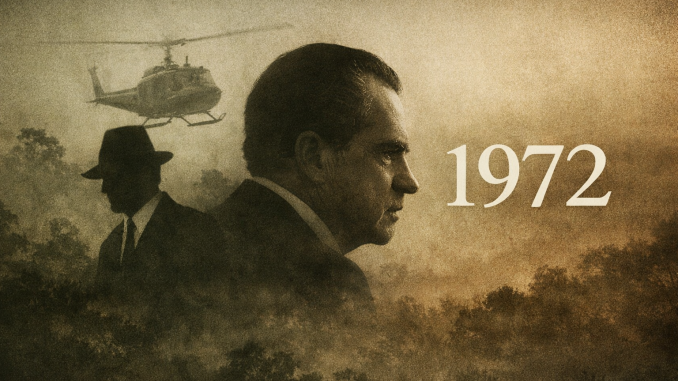
This series approaches each year as a nine-song spread – similar to a tarot reading – drawn by instinct, arranged for flow, and interpreted only after the sequence reveals its shape. What emerges is not a ranking, but a reflection: a portrait of a year told through tone, tension, and transition.
1972: Cultural & Astrological Snapshot
1972 unfolds as a year of realignment beneath the surface.
The Vietnam War continues, but the broader focus begins to shift toward diplomacy and political maneuvering. Richard Nixon’s historic visit to China signals a strategic recalibration on the global stage, while the emerging Watergate scandal quietly introduces a new era of distrust and institutional scrutiny at home.

Popular film reflects both power and vulnerability. The Godfather presents control, loyalty, and hierarchy operating beneath the surface of legitimacy, while The Poseidon Adventure depicts survival within a system suddenly turned upside down.
Astrologically, the United States moves into a more mentally driven and dualistic phase. Saturn in Gemini emphasizes communication, perception, and the consequences of information, highlighting the growing importance of narrative and interpretation. Meanwhile, Uranus and Pluto in Virgo continue to expose systemic flaws, though now with a more methodical and less explosive tone. Neptune in Sagittarius expands the focus toward belief systems, ideology, and global perspective, blurring the line between truth and narrative.
1972 doesn’t declare change. It begins to rearrange the structure…quietly, and not always honestly.
NOTE: The Full Spread playlist is included at the end of this post. (Listen Before, During or After…or Not at All)
Act I – Accountability / Reciprocity / Voice Returns
1972 opens differently. Where previous years often projected outward – assigning blame, idealizing, or misunderstanding – this first movement turns inward. The tone is more grounded, more honest, and notably more balanced.
Responsibility begins to shift. And for the first time in a while, the feminine isn’t just present…it’s allowed to speak.


1. “Let’s Stay Together” – Al Green
This feels like a reset. There’s no posturing, no control, no attempt to dominate the situation. Instead, there’s a genuine willingness to maintain the relationship, even through difficulty.
“Whether times are good or bad…”
The tone is steady, committed, and notably free of projection. The focus isn’t on what the other person is doing wrong…it’s on what can be held together. After years of imbalance, this lands as something new: mutual investment instead of control.
2. “Use Me” – Bill Withers
If Al Green stabilizes the relationship, Bill Withers complicates it, but without shifting the blame.
“If it feels this good getting used…”
The dynamic is uneven, even questionable, but the narrator doesn’t demonize the woman or recast himself as a victim. Instead, he acknowledges his role fully. He’s aware of the situation, and chooses it anyway. The feminine isn’t blamed. The responsibility isn’t displaced. It’s accepted.
3. “You’re So Vain” – Carly Simon
And finally, the perspective flips. A female voice steps forward…not as subject, not as projection, but as critic. The target is clear: narcissism, self-importance, and the same kind of behavior that dominated much of the previous decade. And the detail that sharpens it even further: backing vocals by Mick Jagger. The voice behind “Under My Thumb” now literally supports a critique of that mindset.
The shift is unmistakable. The narrative is no longer one-sided.
Act 1 estabishes a new dynamic. Relationships are acknowledged, not controlled. Responsibility is accepted, not projected. And the feminine is no longer silent…it responds. After years of imbalance, something closer to reciprocity begins to take shape.
Act II – Distance / Identity / Unresolved Masculinity
If Act I suggests balance, Act II complicates it. The shift toward accountability and reciprocity doesn’t fully take hold. Instead, something familiar reasserts itself…not as overt dominance, but as distance, avoidance, and uncertainty about identity.
The masculine role doesn’t disappear. It just becomes harder to define, and harder to live up to.


4. “Mother and Child Reunion” – Paul Simon
The promise is there, but it remains out of reach.
“The mother and child reunion is only a motion away…”
The phrasing suggests closeness, inevitability even…but the reality doesn’t match it. The reunion never quite arrives. It exists more as an idea than an event. What should represent unity instead becomes distance framed as possibility. There’s no rejection here. Just a quiet sense that something meaningful is still…not happening.
5. “Rocket Man” – Elton John
From distance, we move to displacement. The setting expands outward – literally off the planet -but the emotional core contracts. The role being performed is clear, but the identity behind it isn’t.
“I’m not the man they think I am at home…”
The expectation of what a man is supposed to be – present, grounded, connected – doesn’t align with the reality of who he actually is. The environment reflects this. Mars: isolated, masculine, inhospitable. The function is fulfilled. But the identity remains detached from it.
6. “Do It Again” – Steely Dan
And here, the pattern closes in.
“You go back, Jack, do it again…”
The setting shifts to something more grounded – Vegas, chance, repetition – but the core issue remains the same: a loop without change. The character acts, reacts, repeats. What appears as choice reveals itself as compulsion. And once again, the identity doesn’t align with the expectation. The man isn’t who he’s supposed to be. He’s just stuck in the pattern.
Act II reveals what Act I couldn’t resolve. Balance is introduced, but not sustained. And identity begins to separate from expectation. The structure is still in place. But it’s no longer convincing.
Act III – Control / Fear / Reduction
If Act II exposes instability, Act III responds to it. But not with growth.
Instead, the reaction is more familiar: a return to control…subtle in places, more direct in others. The uncertainty around identity doesn’t resolve. It gets redirected into fear, projection, and simplification. The feminine, having briefly regained voice in Act I, is once again reframed. Not as a partner, but as something to be managed.


7. “Superstition” – Stevie Wonder
This is where logic begins to slip.
“When you believe in things that you don’t understand…”
The tone is cautionary, but the presence of superstition itself suggests something deeper: a search for control in a world that no longer feels predictable. When structure weakens, belief systems – rational or not – step in to fill the gap. It’s not clarity. It’s compensation.
8. “Witchy Woman” – Eagles
And here, the feminine is recast again. Not as partner. Not as equal. But as something mysterious, dangerous, and ultimately unknowable.
“She’s a restless spirit on an endless flight…”
Leave a Reply