
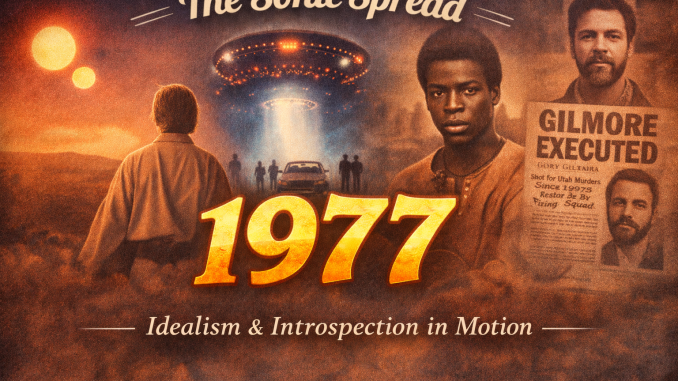
This series approaches each year as a nine-song spread – loosely based on tarot readings – drawn by instinct, arranged for flow, and interpreted only after the sequence reveals its shape. What emerges is not a ranking, but a reflection: a portrait of a year told through tone, tension, and transition.
1977 – Cultural & Astrological Snapshot
1977 expands the frame. In cinemas “Star Wars: A New Hope” reintroduces myth to modern culture with a clear battle between light and dark. Destiny, archetype, and purpose return to the forefront. And “Close Encounters of the Third Kind” shifts the unknown from fear to fascination. The universe is not longer hostile…it is calling.
At the same time, television delivers something far more grounded as “Roots” forces a confrontation with historical truth. Identity is no longer abstract. It is ancestral, painful, and undeniable.
Meanwhile, in the “real world”, the return of capital punishment becomes a national moral reckoning, while Jimmy Carter pardons Vietnam War draft evaders. A symbolic attempt to heal division and redefine justice.
Astrologically speaking, 1977 carries strong Sagittarius / Jupiterian energy, but tempered by deeper undercurrents. This is a Neptune + Jupiter year with expanding imagination (Neptune) and seeking of truth and meaning (Jupiter/Sagittarius). While Pluto quietly insists, “There are still consequences.”
1977 doesn’t stay grounded like 1976. It lifts off, but not blindly. The universe opens, the past resurfaces, and justice is tested. It is a year where myth returns, truth deepens, and perspective expands. 1977 looks to the stars, but refuses to forget the past. It imagines something greater, something beyond the limits of the present, while quietly asking, “Can we evolve without first coming to terms with who we’ve been?”
NOTE: The Full Spread audio playlist is included at the end of this post. (Listen Before, During or After…or Not at All)
ACT I – Illusion, Departure & Forward Motion


1. “The Grand Illusion” – Styx
“We made the grade and still we wonder who the hell we are…”
1977 opens with a direct acknowledgment: the illusion is not gone, it is simply more visible. Styx doesn’t dismantle it; they invite us to recognize it. Fame, success, and perception are revealed as constructs, sustained as much by belief as by reality. Yet there is no urgency to escape, only awareness. The tone is expansive rather than cynical, suggesting that seeing through the illusion is not the end of the story, it is the beginning of something else.
2. “Solsbury Hill” – Peter Gabriel
“I was feeling part of the scenery…I walked right out of the machinery…”
Where awareness begins, departure follows. Gabriel frames leaving not as rejection, but as necessity…an intuitive step away from what no longer fits. There is uncertainty, even vulnerability, but also a quiet sense of rightness. The “machinery” of identity, expectation, and structure is no longer sufficient. What replaces it is not yet clear, but the movement itself carries meaning. This is not escape, it is transition.
3. “Running on Empty” – Jackson Browne
“Running on empty…running blind…”
If departure defines the shift, motion sustains it. Browne captures a state of continual forward movement without full resolution, progress that persists despite depletion. There is honesty in the admission: clarity has not yet been achieved, and energy is not unlimited. Yet the journey continues. The destination remains uncertain, but stopping no longer feels like an option. Movement becomes its own form of purpose.
Act I of 1977 begins not with stability, but with awareness and motion. Reality is recognized as constructed. The individual chooses departure from that construction. The journey becomes ongoing, even without clarity or certainty. Where 1976 rebuilt identity, 1977 begins to move beyond it and toward something larger, less defined, yet still unfolding. The illusion is no longer the destination, but neither is there a clear map beyond it.
ACT II – Generosity, Idealism & the Search for Alignment


1. “Give a Little Bit” – Supertramp
“There’s so much that we need to share, so send a smile and show you care…”
After the forward motion of Act I, Act II begins by turning outward. “Give a Little Bit” introduces generosity as a guiding principle…a simple, almost disarming proposition that connection can be built through openness and exchange. The tone is light, inviting, and sincere, yet its simplicity carries a subtle vulnerability. Giving requires trust, and trust, in a world still shaped by illusion, is never entirely risk-free.
2. “Closer to the Heart” – Rush
“And the men who hold high places…must be the ones to start…”
Where Supertramp offers generosity, Rush introduces responsibility. “Closer to the Heart” expands the focus from individual connection to collective alignment, suggesting that meaningful change requires both integrity and participation. The song carries a sense of idealism, but it is not naïve; it acknowledges structure, hierarchy, and the need for conscious leadership. The “heart” becomes both metaphor and destination…a place where intention and action might finally align.
3. “Point of Know Return” – Kansas
“They say the point demon’s guard is an ocean grave for all the brave…”
By the end of Act II, the optimism begins to tighten into something more urgent. Kansas captures the moment when forward motion and idealism converge into inevitability. The “point of no return” is not framed as a mistake, but as a realization: the journey has progressed too far to reverse. Reflection remains, but it no longer offers escape. What began as openness and aspiration now carries momentum that cannot be easily redirected.
Act II of 1977 explores the attempt to create meaning through connection and purpose. The individual reaches outward through generosity and openness. The collective seeks alignment through intention and responsibility. The journey becomes irreversible, carrying its own momentum forward. What begins as hopeful expansion gradually reveals its weight. The desire for connection and meaning remains strong, but so does the realization that once the path is chosen, it cannot be easily undone. The heart may offer direction, but it does not guarantee control over where that direction leads.
ACT III – Fragmentation, Illumination & Measured Acceptance


7. “Psycho Killer’ – Talking Heads
“I can’t seem to face up to the facts…tension, tension…”
Act III opens with rupture…not external, but internal. “Psycho Killer” strips away the expansive idealism of Act II and replaces it with nervous self-awareness. The voice is fragmented, uncertain, and increasingly unstable, as if the pressure of meaning, movement, and expectation has finally turned inward. What once felt like forward progress now reveals a fractured interior landscape. The danger is no longer abstract – it is psychological.
8. “Mr. Blue Sky” – Electric Light Orchestra
“Mr. Blue Sky…please tell us why you had to hide away for so long…”
From fragmentation emerges a sudden shift…illumination, almost euphoric in its brightness. “Mr. Blue Sky” feels like a clearing, a return of light after tension and uncertainty. Yet even this optimism carries context: the sky had been hidden. The joy is real, but it is also reactive, a response to prior darkness. It suggests that clarity can return, but not without acknowledging the period in which it was absent.
9. “Vienna” – Billy Joel
“Slow down you crazy child…you’re so ambitious for a juvenile…”
Leave a Reply