
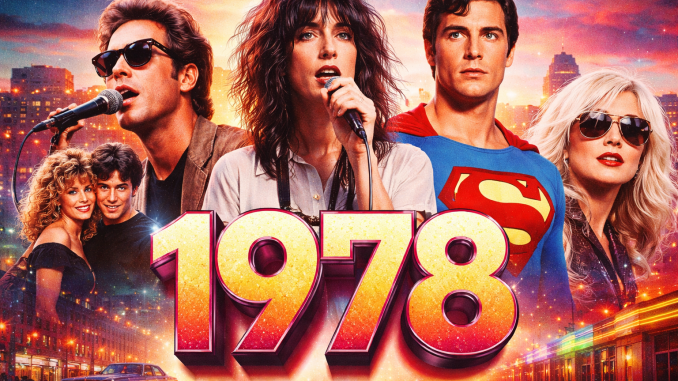
This series approaches each year as a nine-song spread – loosely based on tarot readings – drawn by instinct, arranged for flow, and interpreted only after the sequence reveals its shape. What emerges is not a ranking, but a reflection: a portrait of a year told through tone, tension, and transition.
1978 – Cultural & Astrological Snapshot
1978 was a very slow news year that feels deceptively simple. In theaters, “Grease” dominates with nostalgia, romance, and stylized identity. The past is polished, simplified, and made safe. Youth culture becomes performance…clean, catchy, and contained. “Superman” reintroduces the idea of the pure hero where good and evil are clearly defined. Strength is moral, visible, and reassuring.

But beneath that surface, serial killers and death cults begin to capture national attention. Violence becomes more psychological, less predictable. Fear shifts from external conflict to hidden individuals. Also, Keith Moon dies, a symbol of excess, volatility, and self-destruction. 1978 creates a split reality. The culture looks brighter than it feels.
Astrologically, 1978 carries strong Leo / fire-sign energy, but with deeper, less visible forces shaping the emotional landscape. This is Leo + Scorpio tension year. Leo equals performance, identity, visibility. While Scorpio indicates depth, psychology, and what’s hidden. And Saturn quietly asks, “Is what you’re showing what’s really there?”
NOTE: The Full Spread audio playlist is included at the end of this post. (Listen Before, During or After…or Not at All)
ACT I – Assertion, Projection & One-Sided Narrative


1. “My Life” – Billy Joel
“I don’t care what you say anymore…this is my life…”
1978 opens with declaration. “My Life” presents independence as both stance and defense, an insistence on self-definition that feels as reactive as it does confident. The voice is firm, even defiant, but it is also closed. There is little interest in dialogue, only boundary-setting. Identity here is not negotiated…it is asserted. The perspective is singular, self-contained, and already resistant to outside interpretation.
2. “This Year’s Girl” – Elvis Costello
“You want her broken with her mouth wide open…”
Where Joel establishes control, Costello redirects that control outward. “This Year’s Girl” shifts the focus to the female figure, but only as image, projection, and competition. The subject is present, but not autonomous; she exists within a system of observation and desire. The tone is sharp, almost confrontational, yet the structure remains the same: the voice describing, defining, and framing the narrative from a distance.
3. “Jamie’s Cryin'” – Van Halen
“She wants to send him a letter…but she knows what that’ll get her…”
By the end of Act I, even emotion itself becomes filtered. “Jamie’s Cryin’” introduces feeling, but not from the source. Instead, it is translated, interpreted, and ultimately diminished through the same singular perspective established at the beginning. The female voice attempts to emerge, but it never fully arrives. What we hear instead is a version of it…mediated, simplified, and controlled.
Act I of 1978 establishes a world defined by a single dominant voice. Identity is asserted without dialogue. Others are observed and projected upon. Emotion is interpreted rather than expressed directly. The structure is clear, consistent, and largely unquestioned. The voice is confident, but is also alone…and unaware of what it’s not hearing.
ACT II – Emergence, Collision & Misalignment


4. “Because the Night” – The Patti Smith Group
“Because the night belongs to lovers…”
Act II opens with a fundamental shift: the voice is no longer observing, it is experiencing. Patti Smith doesn’t describe desire from a distance; she inhabits it fully, with urgency and ownership. The tone is raw, direct, and unfiltered, operating outside the detached framing of Act I. There is no attempt to explain or justify, only to express. For the first time, the perspective is not constructed around the subject… it is the subject.
5. “Shattered” – The Rolling Stones
“Pride and joy and greed and sex…that’s what makes that town the best…”
The entrance of a different voice doesn’t create harmony, it reveals instability. “Shattered” captures a world already in fragments, where overstimulation and disconnection have become the norm. The energy is restless, scattered, and unresolved, as if the system itself cannot fully process what it’s encountering. The presence of multiple perspectives doesn’t clarify reality…it complicates it.
6. “Roxanne” – The Police
“You don’t have to put on the red light…”
By the end of Act II, the attempt to reassert control returns, but it feels incomplete. “Roxanne” addresses a woman directly, yet still from an external vantage point. There is concern, even empathy, but also assumption. The voice seeks to redefine her situation, to offer an alternative…but it remains outside her experience. The pattern persists: the subject is spoken to, but not fully heard.
Act II of 1978 introduces a new voice… and exposes the system’s inability to absorb it. Expression becomes direct, embodied, and self-defined. The environment reveals itself as fragmented and overstimulated. The dominant voice attempts re-engagement, but remains external. What emerges is not balance, but tension. The perspectives coexist, but they do not align. The voice is no longer alone, but it still doesn’t know how to listen.
ACT III – Deconstruction, Detachment & Dark Reflection


7. “(I Can’t Get No) Satisfaction” – Devo
“Can’t you see I’m on a losing streak…”
Act III opens with distortion. Devo takes a familiar expression of frustration and strips it of its original swagger, replacing it with something mechanical and disjointed. Desire is no longer passionate. it is repetitive, programmed, and oddly hollow. The voice that once dominated now feels disconnected from itself, as if it has become a caricature of its own impulses. What was once confident now borders on absurd.
8. “Heart of Glass” – Blondie
“Once I had a love…and it was a gas…”
From that distortion emerges a different kind of clarity. “Heart of Glass” doesn’t argue or confront…it observes. The tone is cool, detached, and emotionally precise, offering a perspective that neither seeks approval nor reacts to the surrounding noise. Where earlier voices projected or interpreted, this one simply reflects. The result is subtle but powerful: a presence that exists on its own terms, unaffected by the frameworks around it.
9. “Excitable Boy” – Warren Zevon
“Well he took little Suzie to the junior prom…”
Leave a Reply