
This series approaches each year as a nine-song spread – loosely based upon tarot readings – drawn by instinct, arranged for flow, and interpreted only after the sequence reveals its shape. What emerges is not a ranking, but a reflection: a portrait of a year told through tone, tension, and transition.
1971: Cultural & Astrological Snapshot
1971 continues the slow shift from upheaval to aftermath and consequence.
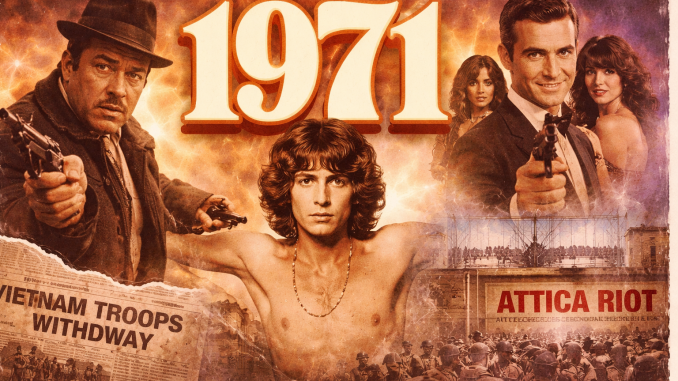
The Vietnam War remains ongoing, but U.S. troop withdrawals signal a gradual disengagement rather than escalation. At home, the Attica Prison Riot exposes deep fractures within American institutions, bringing issues of authority, control, and human rights into sharper focus. The death of Jim Morrison marks another symbolic closing of the 1960s, as one of its most volatile and mythic figures disappears.

Popular film reflects a world grounded more in realism and tension. The French Connection presents a gritty, procedural view of crime and control, while Diamonds Are Forever continues the stylized fantasy of power, wealth, and global intrigue.
Astrologically, the United States moves through a period of recalibration. Saturn in Taurus continues to enforce limits and consequences, demanding stability after years of excess. The ongoing influence of Uranus and Pluto in Virgo keeps pressure on systems and institutions, though the energy now feels less explosive and more corrective and systemic. Meanwhile, Neptune in Sagittarius begins to shift the collective focus toward belief, ideology, and the search for meaning beyond the material world.
1971 doesn’t break from the past. It begins to sort through it…more grounded, but still unsettled.
NOTE: The Full Spread playlist is included at the end of this post. (Listen Before, During or After…or Not at All)
Act I – Drift / Dislocation / Emotional Escape
If 1970 ended with movement but uncertainty, 1971 begins with disorientation. There’s no clear direction forward…only environment, emotion, and a growing sense of distance. Water moves through these songs, but not as renewal. Instead, it appears as something missing, separating, or just out of reach.
The result is a kind of drift. Not collapse. Not resolution. Just being somewhere without knowing how, or why, you got there.


1. “A Horse With No Name” – America
We begin in the desert. After the tentative forward motion of 1970, this feels like a loss of orientation with its wide-open space, no structure, no clear path.
“The ocean is a desert with its life underground…”
Water is present, but only in theory…hidden, inaccessible. What should sustain life is buried beneath the surface, replaced by something that only appears complete from a distance. Even the name America lands differently here. Not expansive, not hopeful, but strangely empty.
By the end, there’s no breakthrough. No discovery. Just endurance…that starts to feel like resignation.
2. “Uncle Albert / Admiral Halsey” – Paul McCartney
From the desert, we move to the ocean, but the shift doesn’t resolve anything. Instead, it fragments. The song drifts between sections, moods, and voices, echoing the medley structure of Abbey Road, but without the same sense of cohesion or purpose. What once felt unified now feels disconnected.
“We’re so sorry Uncle Albert…”
Everything becomes apology, politeness, deflection. Even the imagery of water – storms, seas, distance – doesn’t ground the experience. It separates. What should feel like movement instead feels like being carried along without control.
3. “River” – Joni Mitchell
Mitchell, the only consistent female voice thus far returns to water in its clearest form. But it isn’t something to cross, or discover, or understand. It’s something to escape into.
“I wish I had a river I could skate away on…”
The desire isn’t for resolution, it’s for distance. To leave the situation entirely, to glide away from consequence, emotion, and responsibility. Where 1970 suggested movement forward, this is movement away. Not toward anything new. Just away from what is.
Act I doesn’t establish direction. Water is hidden. Water divides. Water becomes escape. Across all three songs the pattern holds. What should sustain or guide instead becomes something unreachable, unstable, or avoided. The year doesn’t begin with purpose. It begins with drift.


Act II – Subtle Confrontation / Contained Tension / Return of the Edge
If Act I drifts, Act II responds…but carefully. The confrontational energy that defined the late 60s hasn’t disappeared. It’s been tempered, redirected into something less explosive and more controlled. The tone is calmer, the delivery smoother, but the underlying tension remains.
This isn’t the street. It’s something quieter. But not necessarily less intense.
4. “What’s Going On” – Marvin Gaye
This is confrontation without aggression. The mood is warm, almost inviting, but the questions underneath are direct. There’s no shouting, no demand, just a steady insistence that something isn’t right. The appeal is human, relational, grounded in shared experience rather than opposition. But it’s still defiance. Just expressed in a way that can’t be easilty rejected.
5. “The Revolution Will Not Be Televised” – Gil Scott-Heron
If Gaye softens confrontation, Scott-Heron redirects it. The urgency is still there, but instead of anger, he uses humor, rhythm, and repetition to dismantle expectations. The message cuts through without needing to escalate. There’s a sense that the militant edge is being held back…channeled rather than unleashed. The confrontation becomes intellectual, almost conversational. But no less pointed.
6. “Bitch” – The Rolling Stones
And then the restraint gives way. What had been controlled, measured, and indirect snaps back into something more familiar…raw, impatient, and unapologetically blunt.
“When you call my name I salivate like a Pavlov dog…”
The language changes, but the impulse doesn’t. The dissatisfaction that drove earlier confrontations hasn’t been resolved, it’s been waiting. And here, it returns stripped of pretense. The conclusion is simple, and telling:
“Love, it’s a bitch…”
Whatever subtlety existed before collapses into frustration without resolution. But ultimately, the underlying tension remains unchanged. The same dissatisfaction surfaces again, just expressed differently along the way. What begins as subtle defiance ends where it started: unresolved, and still searching for something that holds.
Act III – Maturity / Illusion / Final Reckoning
By Act III, something resembling clarity begins to emerge. The tone shifts again…less drifting, less contained tension, and more direct acknowledgment. There’s a sense of maturity here, a recognition that constant confrontation isn’t sustainable.
But that clarity doesn’t hold. Because the voices leading this section are not new ones, they are the same figures who helped define the previous decade. And what they bring isn’t resolution. It’s a final reckoning.


7. “Baba O’Riley” – The Who
This feels like growth…at least at first.
“I don’t need to fight to prove I’m right…”
The confrontational energy that once defined the band has softened. There’s less need to assert, less need to dominate. It sounds like maturity. But the ending tells a different story.
“They’re all wasted…”
Whatever progress has been made doesn’t translate into direction. The clarity is there, but it exists alongside a culture still caught in excess and drift. Maturity arrives. But it doesn’t fix anything.
8. “Going to California” – Led Zeppelin
Here, the illusion is addressed more directly. The destination – California, long associated with the promise of the 60s – no longer holds the same meaning. The search continues, but the object of that search feels increasingly abstract.
“Trying to find a woman who’s never, never, never, been born…”
What was once pursued as possibility now appears as projection, something imagined, not found. The summer of love isn’t rejected outright. It’s quietly revealed to have been unattainable from the start.
9. “L.A. Woman” – The Doors
And finally, the tone shifts completely. If The Allman Brothers burned down the emotional core of the 60s with “Whipping Post,” this feels like the architects of the atmosphere themselves returning for a final pass.
There’s no nostalgia here. No softness. The energy is heavier, darker, more grounded in the physical reality of the place that once symbolized something larger. Los Angeles isn’t myth anymore. It’s environment. And the mood follows: from something once glad to something now unmistakably sad. The transformation is complete.
Act III doesn’t resolve the year. Illusions are exposed and the original voices return, not to restore, but to close the loop. The 60s aren’t revived. They’re revisited…and left behind.
Final Thought: 1971 doesn’t break from the past. It walks through it one last time…more aware, less convinced, and ultimately less attached. What remains isn’t promise. It’s the understanding that the promise was never fully real to begin with.
Leave a Reply