
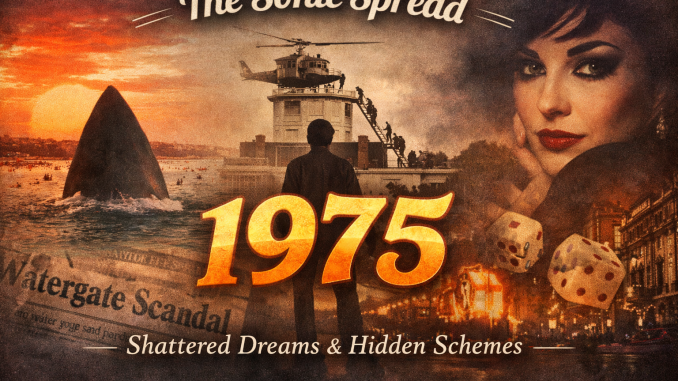
This series approaches each year as a nine-song spread – loosely based on tarot readings – drawn by instinct, arranged for flow, and interpreted only after the sequence reveals its shape. What emerges is not a ranking, but a reflection: a portrait of a year told through tone, tension, and transition.
1975: Cultural & Astrological Snapshot
1975 feels like the year where external conflict gives way to internal unrest. Jaws dominates cinemas, turning the unknown into cultural obsession. The threat is invisible, lurking beneath the surface. On the other hand, One Flew Over the Cuckoo’s Nest presents a different kind of horror: not a monster, but the system itself…authority, control, and enforced conformity.
Meanwhile, in the real world, The Vietnam War finally ends with the fall of Saigon. Not triumph, but exhaustion. A long narrative simply…collapses. The fallout from the Watergate Scandal continues to erode public trust. Authority is no longer assumed to be legitimate. 1975 shifts the focus from “What is happening out there?” to “What is happening beneath the surface and who is really in control?”

1975 isn’t explosive like 1968. It’s more unsettling than that. The war ends, but there’s no resolution. The system is exposed, but nothing replaces it. The threat isn’t visible, but everybody feels it. This is a Neptune and Pluto year where illusions dissolve and power structures mutate. And Virgo quietly asks, “Now that we see the flaws, what do we actually fix?”
NOTE: The Full Spread audio playlist is included at the end of this post. (Listen Before, During or After…or Not at All)
ACT I – Image, Aspiration & Manufactured Identity


1. “Fame” – David Bowie
“Fame…what you need you have to borrow…”
Fame doesn’t arrive as a reward, it arrives as a transaction. Bowie opens 1975 not with rebellion, but with a groove so smooth it almost conceals the warning embedded within it. Identity here is no longer self-generated; it is negotiated, borrowed, and ultimately owned by something outside the self. The rhythm seduces, but the message quietly unsettles: recognition comes at a cost, and the price is often invisible at the outset.
2. “Shining Star” – Earth, Wind & Fire
“You’re a shining star, no matter who you are…”
Where Bowie hints at external validation, Earth, Wind & Fire respond with affirmation…but even this empowerment carries an interesting tension. “Shining Star” radiates confidence, yet its language suggests that worth must still be declared, reinforced, and believed through repetition. It is uplifting, undeniably so, but it also reflects a cultural moment where identity increasingly requires confirmation. The self is strong…but only once it has been named and recognized.
3. “Jive Talkin” – Bee Gees
“You’re tellin’ me lies, yeah…jive talkin…”
By the time the Bee Gees arrive, the cracks in the surface are no longer subtle. Communication itself becomes suspect. The groove remains irresistible – arguably even more so – but now it carries deception within it. Words lose their grounding, replaced by performance, manipulation, and misdirection. If “Fame” introduced the transaction and “Shining Star” affirmed the identity, “Jive Talkin’” reveals the instability of the entire exchange.
Act I of 1975 presents a world that still functions, but only on the surface. Identity is constructed, affirmed, and finally distorted through language. What begins as aspiration gradually reveals itself as performance. The rhythm is smooth, the confidence is high, but something essential has already been compromised. The illusion hasn’t collapsed yet, but it’s no longer entirely convincing.
ACT II – Exit, Temptation & Entanglement


4. “50 Ways to Leave Your Lover” – Paul Simon
“Slip out the back, Jack…make a new plan, Stan…”
If Act I exposed the instability of identity, Act II begins with an attempt to quietly disengage from it. Simon presents departure not as confrontation, but as strategy, almost casually procedural. The tone is light, even playful, yet the implications are heavier: connection is no longer something to repair, but something to exit. There is no dramatic rupture here, only a series of small evasions. Freedom, in this moment, is framed not as truth, but as avoidance.
5. “One of These Nights” – Eagles
“You got your demons and you got desires…I’ve got a few of my own”
The escape, however, does not lead to clarity…it leads to pursuit. The Eagles cloak longing in smooth, nocturnal confidence, but beneath it lies a restless uncertainty. What is being sought is never clearly defined, only felt as something just out of reach. Desire becomes directional without being purposeful. The night offers possibility, but also concealment. What feels like discovery may simply be another form of wandering.
6. “Evil Woman” – Electric Light Orchestra
“Evil woman…how you done me wrong…”
By the end of Act II, the consequences of that wandering begin to take shape. What first appeared as opportunity now reveals itself as entanglement. ELO frames the experience as betrayal, but there is an underlying suggestion that the danger was always present…only ignored. The orchestration adds a sense of drama, but the lesson is simple: not all connections are liberating. Some merely replace one form of illusion with another.
Act II of 1975 traces the movement away from illusion… and directly into another. Escape is strategic but shallow. Desire becomes restless and undefined. Connection turns complicated and costly. What begins as freedom gradually reveals itself as substitution. The system may have been left behind, but its patterns persist…reappearing through desire, projection, and misjudgment. The illusion has been internalized.
ACT III – Embodiment, Detonation & Existential Collapse


7. “Slow Ride” – Foghat
“Move to the music, we can roll all night…”
After the missteps of Act II, the focus shifts from mind to body. “Slow Ride” doesn’t rush, it settles in, locking into a physical groove that feels grounded, immediate, and undeniable. There is no searching here, no questioning, no strategy…only sensation. Yet even in its steadiness, there is a quiet escalation. What begins as control gradually leans toward indulgence. The body takes the lead, but without clear direction, it risks becoming another form of surrender.
8. “T.N.T.” – AC/DC
“I’m dynamite…I’m a power load…”
Any illusion of control established in “Slow Ride” is obliterated here. “T.N.T.” is pure declaration, identity stripped down to force, volume, and impact. There is no nuance, only presence. It’s the logical extreme of embodiment: when reflection disappears, action becomes absolute. The energy is undeniable, but so is its volatility. This is not balance…it is ignition without restraint.
9. “Bohemian Rhapsody” – Queen
“Nothing really matters…anyone can see…”
Leave a Reply