
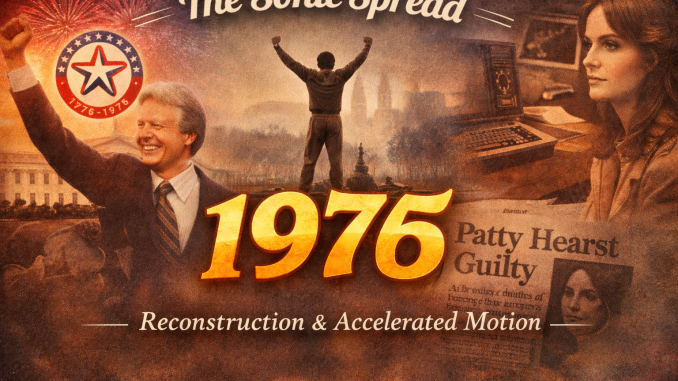
This series approaches each year as a nine-song spread – loosely based on tarot readings – drawn by instinct, arranged for flow, and interpreted only after the sequence reveals its shape. What emerges is not a ranking, but a reflection: a portrait of a year told through tone, tension, and transition.
1976 – Cultural & Astrological Snapshot
1976 presents itself as a year of renewal and confidence, but much of that confidence feels constructed, even performative. “Rocky” becomes the defining cultural story. The underdog rises, not through talent alone, but through endurance. Victory is reframed, going the distance becomes enough. Conversely, “A Star is Born” revisits fame as both aspiration and destruction. Success and collapse are now inseparable. The spotlight elevates, but it also consumes.
Meanwhile, in the “real world”, Jimmy Carter is elected president, a return to humility and moral language after the cynicism of Watergate. America celebrates its Bicentennial, a massive national effort to reconnect with origin, identity, and purpose. Celebration as reassurance. Quietly, the future begins to take shape…not in culture, but in code, with the founding of both Apple and Microsoft. Finally, Patty Hearst, a lingering symbol of psychological manipulation, identity fracture, and media spectacle, is found guilty.

1976 asks, “Who are we now?”, but the answer comes in the form of comeback stories, nostalgic celebrations, and carefully rebuilt narratives. Identity is no longer assumed…it must reconstructed and performed.
1976 then says, “Get back up, Try again. Reclaim something”, but underneath the belief systems are still unstable (Neptune). The power structures are still shifting (Pluto). The psyche is still being exposed (Uranus). And Saturn quietly asks, “Is this confidence real…or rehearsed?” The story continues, but now we’re aware that it can be rewritten.
NOTE: The Full Spread audio playlist is included at the end of this post. (Listen Before, During or After…or Not at All)
ACT I – Grounding, Reassurance & Reclaimed Identity


1. “Peace of Mind” – Boston
“I understand about indecision…but I don’t care if I get behind…”
After the unraveling of the previous year, “Peace of Mind” arrives as a quiet declaration of independence…not from society itself, but from its expectations. There is no urgency here, no need to compete or conform. Instead, the song reframes success as something internal, self-defined, and deliberately detached from external pressure. It doesn’t reject the system outright, it simply steps outside of it. In doing so, it establishes a new foundation: identity that does not require validation.
2. “Still the One” – Orleans
“You’re still the one that makes me laugh…”
Where Boston asserts independence, Orleans offers continuity. “Still the One” is warm, familiar, and grounded in connection, not the fragile, transactional connections of 1975, but something steadier and more enduring. It suggests that not everything needs to be rebuilt from scratch. Some bonds survive the turbulence, providing a sense of stability in a shifting landscape. The tone is reassuring, almost nostalgic, reinforcing the idea that identity can be anchored in what remains consistent.
3. “Mainstreet” – Bob Seger
“When I’m feelin’ lonely and beat, I drift back in time and I find my feet…”
Seger closes Act I by turning inward, but not into confusion…into memory. “Mainstreet” reflects on experience with a sense of distance, observing rather than reacting. There is a recognition here that what once felt immediate now exists as part of a larger personal narrative. It neither glorifies nor condemns the past; it simply acknowledges it. In doing so, it deepens the grounding established earlier in the act: identity is not just chosen or shared, it is also remembered.
Act I of 1976 shifts away from illusion and toward stabilization. Identity becomes self-defined and internally anchored. Connection becomes steady and reaffirmed. Experience becomes integrated through reflection. Where 1975 questioned everything, 1976 begins by reclaiming something…quietly, deliberately, and without spectacle. The world may still be uncertain, but the self is beginning to find its footing again.
ACT II – Elevation, Escape & Sensory Immersion


4. “Fly Like an Eagle” – Steve Miller Band
“Time keeps on slippin’, slippin’, slippin’…into the future…”
If Act I grounded the self, Act II begins by lifting it out of time altogether. “Fly Like an Eagle” drifts forward with a sense of calm inevitability, as if movement itself is enough to justify direction. The desire here is not to confront or rebuild, but to transcend…to rise above the noise, the pressure, and the weight of the past. Yet in doing so, time itself begins to blur. Progress feels less like a path and more like a drift, raising a subtle question: is this evolution… or simply escape at a higher altitude?
5. “You Should Be Dancing” – Bee Gees
“What you doin’ on your back…you should be dancing…”
Any lingering distance from the body disappears here. The Bee Gees pull everything back into physical immediacy, where movement replaces thought and rhythm overrides reflection. There is no ambiguity, only instruction. Participation becomes expectation. The dance floor offers release, but it also demands compliance. What feels like freedom may, in fact, be another form of alignment: the individual dissolving into collective motion.
6. “Love Hangover” – Diana Ross
“If there’s a cure for this…I don’t want it…”
By the end of Act II, sensation has fully taken over. “Love Hangover” begins in restraint but quickly gives way to immersion…longer, deeper, and more consuming than the previous track. What starts as experience becomes dependency. The language itself resists resolution: there is no desire to recover, only to continue. Pleasure lingers, but so does its aftereffect. The boundary between enjoyment and entanglement fades, leaving behind something that feels both irresistible and unsustainable.
Act II of 1976 moves from stability into elevation, and then into immersion. Perspective becomes detached and future-facing. Experience becomes physical and collective. Sensation becomes prolonged and consuming. What begins as transcendence gradually becomes absorption. The self, once grounded, now risks dissolving…not through confusion, but through excess. The question is no longer, “Who am I?” but how far can this feeling carry me…before it turns?
ACT III – Acceptance, Reckoning & Accelerated Living


7. “Don’t Fear the Reaper” – Blue Oyster Cult
“Romeo and Juliet…are together in eternity…”
Act III opens not with resistance, but with acceptance. “Don’t Fear the Reaper” removes the urgency that defined earlier stages and replaces it with something calmer, almost serene. Mortality is no longer something to outrun…it is something to understand, even embrace. The tone is neither dark nor dramatic, but oddly peaceful, suggesting that fear itself may have been the greater burden. In the aftermath of Act II’s excess, this moment feels like clarity: an acknowledgment of limits that paradoxically creates space for meaning.
8. “Carry On Wayward Son” – Kansas
“Carry on my wayward son…there’ll be peace when you are done…”
Where acceptance creates stillness, Kansas introduces purpose. “Carry On Wayward Son” reframes the journey, not as aimless wandering, but as something that can still resolve into understanding. The search continues, but now with a sense that it leads somewhere, even if that destination remains undefined. There is tension between struggle and reassurance, between movement and rest. The promise of peace exists, but it is deferred, contingent on the continuation of the path itself.
9. “Life in the Fast Lane” – Eagles
“Life in the fast lane…surely make you lose your mind…”
Leave a Reply