
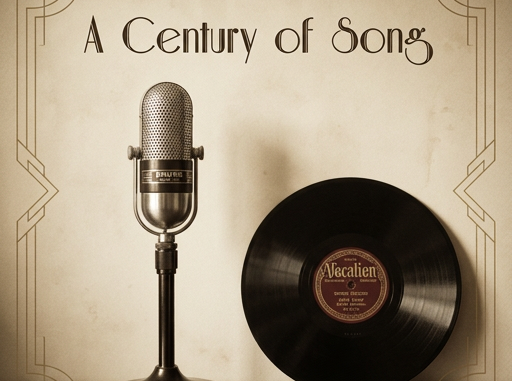
A century ago, these musicians were making records without any idea what popular music would sound like one hundred years later, or whether anyone would still be listening to them at all. They certainly could not have imagined streaming, digital archives, or artificial intelligence, much less that the same technology now helping people manufacture songs from thin air might also help us rediscover recordings made when the microphone itself still felt like modern wizardry.
That is part of the fascination of this project. Technology keeps pushing music forward, sometimes whether we ask it to or not, but it also gives us an extraordinary chance to look backward, recover what was nearly lost, and hear the past without treating it like a museum exhibit.
Every journey begins with a first step. This is ours: one song at a time, one artist at a time, moving through a century of recorded music to see what still speaks, what still surprises, and what stubbornly refuses to disappear.
| PLAYLIST | |
| Worried Man Blues (2:42) | The Carter Family (1930) |
| T.B. Blues (3:01) | Jimmie Rodgers (1931) |
| God Moves on the Water (3:03) | Blind Willie Johnson (1930) |
| I Need a Little Sugar in My Bowl (2:49) | Bessie Smith (1931) |
| Careless Love (3:00) | Lonnie Johnson (1928) |
| When You’re Smiling (4:05) | Louis Armstrong (1930) |
| Georgia on My Mind (3:59) | Hoagy Carmichael (1930) |
| When I Take My Sugar to Tea (3:14) | The Boswell Sisters (1931) |
| Tiger Rag (1:57) | The Mills Brothers (1931) |
| South (2:35) | Bennie Moten (1928) |
| It Don’t Mean a Thing (If It Ain’t Got That Swing) (3:09) | Duke Ellington (1932) |
| Keepin’ Out of Mischief Now (3:27) | Fats Waller (1932) |
| Reefer Man (2:57) | Cab Calloway (1932) |
| Alexander’s Ragtime Band (3:04) | The Boswell Sisters (1934) |
| Heatwave (3:13) | Ethel Waters (1933) |
| On the Sunny Side of the Street (2:56) | Louis Armstrong (1934) |
| Don’t Be That Way (2:27) | Chick Webb (1934) |
| I’m Gonna Sit Right Down and Write Myself a Letter (3:30) | Fats Waller (1935) |
| Blue Skies (3:35) | Benny Goodman (1935) |

The Carter Family – “Worried Man Blues” (1930)
The Carter Family sit very near the foundation of recorded country music. A. P. Carter, Sara Carter, and Maybelle Carter emerged from the landmark 1927 Bristol Sessions, recordings the Library of Congress describes as a watershed in country-music history. Their repertoire helped carry Appalachian ballads, hymns, folk songs, and traditional melodies into the commercial-recording age, while Maybelle Carter’s influential guitar playing helped establish the instrument as something more than rhythmic accompaniment. “Worried Man Blues” became one of their major early recordings.
“Worried Man Blues” is an ideal doorway into the century because it already contains something that will recur endlessly in American popular music: misery made strangely pleasurable. The lyric is full of imprisonment, worry, and resignation, yet the Carters deliver it with an easy rhythmic momentum and wonderfully plainspoken harmony. There is nothing ornate about the recording; its power comes from repetition, melody, and the feeling that this song existed long before anybody thought to put a microphone in front of it. Ninety-six years later, that simplicity is precisely why it still works.

Jimmie Rodgers – “T.B. Blues” (1931)
Jimmie Rodgers was one of the first true stars of country music and one of the figures who helped define what the solo country singer could be. Drawing from folk music, railroad songs, vaudeville, jazz, and especially the blues, Rodgers created a highly personal style that influenced generations of performers from Ernest Tubb and Hank Snow to Johnny Cash and Merle Haggard. His career was remarkably brief, he recorded from 1927 until his death in 1933, but his impact was enormous.
“T.B. Blues” is especially haunting because Rodgers was not merely borrowing somebody else’s tragedy: he had been diagnosed with tuberculosis years earlier and would ultimately die from the disease. That knowledge gives the song an unnerving intimacy. Yet Rodgers never wallows in it; the performance remains relaxed, melodic, and almost conversational. It is an early example of something country music would become extraordinarily good at…turning personal suffering into music that is direct, memorable, and somehow pleasurable to hear.

Blind Willie Johnson – “God Moves on the Water” (1930)
Blind Willie Johnson occupies a unique place where gospel, blues, and early American folk tradition overlap. His recordings were religious in subject but blues-based in sound, driven by one of the most distinctive voices and slide-guitar styles of the prewar era. Though he recorded only a small body of work between 1927 and 1930, his influence reached far beyond gospel into blues, rock, and folk music; later generations treated his records less as period curiosities than as elemental American music.
“God Moves on the Water” takes the 1912 sinking of the Titanic and turns it into a stark spiritual warning. Johnson’s rasping vocal and urgent guitar make the disaster feel immediate rather than historical, while the song’s religious interpretation gives it the quality of an old testament sermon delivered through the blues. It is grim, hypnotic, and remarkably vivid…a reminder that some of the earliest recorded popular music could already sound genuinely apocalyptic.

Bessie Smith – “I Need a Little Sugar in My Bowl” (1931)
Bessie Smith was the dominant female blues singer of the 1920s and one of the first major stars of recorded African American music. Known as the “Empress of the Blues,” she brought enormous vocal authority, theatrical timing, and emotional directness to material that ranged from heartbreak and poverty to sex, drinking, and survival. Her recordings helped define the classic blues style and influenced generations of singers well beyond the genre.
“I Need a Little Sugar in My Bowl” shows exactly why Smith could make suggestion sound more powerful than explicitness. The song is packed with sexual double entendre, but her delivery is controlled, amused, and completely self-possessed rather than coy. What could have become a novelty number instead feels sophisticated and adult…a sly reminder that popular music was dealing with desire quite openly long before rock and roll supposedly invented the subject.

Lonnie Johnson – “Careless Love” (1928)
Lonnie Johnson was one of the most sophisticated guitarists to emerge from the early blues era and an important bridge between blues, jazz, and later popular guitar styles. His fluid single-note playing, elegant phrasing, and unusually polished musicianship influenced generations of guitarists, even though his own name never became as universally recognized as some of the artists who followed him.
“Careless Love” is admittedly a chronological cheat in this project, but a useful one. The song itself predates 1930, and the version we’re using comes from much later, yet it slips into the sequence without sounding remotely misplaced. Johnson’s performance has that rare quality of seeming both antique and timeless: graceful guitar, relaxed vocal phrasing, and none of the stiffness that can sometimes mark early recordings. In a century-long survey, it earns its place not because it obeys the rules, but because it quietly exposes how artificial those rules can be.

Louis Armstrong – “When You’re Smiling” (1930)
Louis Armstrong was one of the central architects of twentieth-century popular music. As a trumpeter, singer, and improviser, he helped shift jazz away from primarily ensemble-based performance toward the featured soloist, while his rhythmic phrasing and gravelly vocal style permanently changed the way American singers approached popular song. His influence extends so far beyond jazz that it is difficult to imagine later swing, pop, rhythm and blues, or even rock-era vocal phrasing developing quite the same way without him.
“When You’re Smiling” captures Armstrong at his most immediately accessible. The melody is simple and optimistic, but his phrasing keeps it from sounding merely sentimental; he bends the rhythm, leans into certain words, and gives the song a conversational looseness that feels remarkably modern. It is an excellent early reminder that Armstrong’s greatness was not only about technical brilliance…he could make even the most straightforward popular tune sound unmistakably like Louis Armstrong.

Hoagy Carmichael – “Georgia on My Mind” (1930)
Hoagy Carmichael was one of the great American songwriters of the pre-rock era, a composer whose work helped define the sophisticated popular song without ever feeling overly formal. He moved comfortably between jazz, Tin Pan Alley, and film music, writing melodies that were elegant enough for musicians to explore yet direct enough to become standards. His catalog includes several songs that became permanent fixtures of American music.
“Georgia on My Mind” is the clearest example of Carmichael’s gift for writing a melody that seems inevitable once you hear it. The 1930 recording is more restrained than the versions that would later make the song famous, but that restraint is part of its charm: the tune carries the emotion without needing to announce it. Long before Ray Charles transformed it into a soul landmark, Carmichael had already created the essential architecture…a wistful, beautifully shaped song that somehow feels both personal and universal.

The Boswell Sisters – “When I Take My Sugar to Tea” (1931)
The Boswell Sisters were among the most inventive vocal groups of the early 1930s and a crucial link between jazz singing and the close-harmony pop groups that followed. Connee, Martha, and Vet Boswell treated songs almost like raw material, altering tempos, rhythms, phrasing, and arrangements with a freedom that was highly unusual for popular vocal music of the period. Their influence can be heard in later groups such as the Andrews Sisters, but their own records remain far stranger, looser, and more rhythmically adventurous than most of their imitators.
“When I Take My Sugar to Tea” is a perfect example of how they could take a lightweight popular tune and make it feel alive. The performance skips along with playful harmonies and constant little rhythmic shifts, giving the song an almost mischievous personality. Rather than simply presenting the melody, the Boswells seem to be rearranging it while they sing, which is exactly what makes the record sound so fresh nearly a century later.

The Mills Brothers – “Tiger Rag” (1931)
The Mills Brothers were one of the most important vocal groups in early popular music, famous not only for their close harmonies but for their uncanny ability to imitate instruments with their voices. In their early recordings, they could make a four-man vocal group sound like a miniature jazz band, helping expand the possibilities of vocal performance and paving the way for generations of harmony groups in jazz, pop, R&B, and doo-wop.
“Tiger Rag” is the ideal showcase for that trickery. The song itself was already a jazz standard, but the Mills Brothers turn it into something playful and almost surreal, blurring the line between singing and instrumentation. The speed, precision, and sheer novelty are impressive, but the real reason it survives is that the performance is fun rather than merely clever. It sounds like four musicians discovering, in real time, just how much noise they can make without actually carrying a band with them.

Bennie Moten – “South” (1928)
Bennie Moten was one of the key architects of the Kansas City jazz sound and an essential precursor to the swing era. His orchestra emphasized a looser, bluesier rhythmic feel than many contemporary dance bands, and its personnel eventually fed directly into Count Basie’s groundbreaking band. Moten’s importance lies partly in that transition: his recordings show big-band jazz beginning to shed stiffness and discover the propulsion that would soon define swing.
“South” is our other chronological cheat, but it earns the indulgence easily. Recorded in 1928, it already points forward, with an easy rolling pulse and relaxed ensemble sound that sit comfortably beside the early-1930s material. Rather than feeling like a relic from the previous decade, it sounds like a preview of what jazz was about to become…which makes bending the calendar feel less like cheating than good sequencing.

Duke Ellington – “It Don’t Mean a Thing (If It Ain’t Got That Swing)” (1932)
Duke Ellington was one of the most important composers, bandleaders, and arrangers in American music. Over a career spanning more than five decades, he expanded the possibilities of jazz orchestration and treated the big band as a highly individual compositional instrument rather than simply a vehicle for dance music. His work helped move jazz toward greater sophistication without sacrificing rhythm, personality, or entertainment.
“It Don’t Mean a Thing” is one of those rare recordings whose title effectively names an entire musical principle. With Ivie Anderson’s exuberant vocal and the band’s relentless rhythmic drive, the song turns “swing” into something you can feel before you ever try to define it. It is catchy, playful, and historically significant all at once…and it announces, with remarkable confidence, the rhythmic language that would dominate much of the next decade.

Fats Waller – “Keepin’ Out of Mischief Now” (1932)
Fats Waller was one of the great personalities of early jazz: a brilliant stride pianist, gifted songwriter, singer, and entertainer whose humor sometimes obscured just how formidable a musician he was. His playing helped carry the Harlem stride tradition into the swing era, while songs such as “Ain’t Misbehavin’” and “Honeysuckle Rose” became enduring standards.
“Keepin’ Out of Mischief Now” shows the gentler side of Waller’s charm. Instead of leaning heavily on comic exuberance, he delivers the song with warmth, rhythmic ease, and an almost conversational intimacy. The piano keeps everything buoyant, but the performance never rushes; it simply glides. It is a lovely reminder that Waller did not need to be clowning to be irresistible.

Cab Calloway – “Reefer Man” (1932)
Cab Calloway was one of the most charismatic bandleaders and entertainers of the swing era, blending jazz, theatrical showmanship, scat singing, and a larger-than-life stage persona. His orchestra was musically formidable, but Calloway also understood spectacle, helping turn the big-band frontman into something closer to a modern pop star.
“Reefer Man” is wonderfully sly period humor built around a subject that was far less innocent than the jaunty arrangement suggests. The song treats marijuana use as comic character study, and Calloway’s animated delivery makes the whole thing feel like a miniature nightclub sketch. Beneath the novelty, though, the band swings hard, which is why the record survives as more than just a historical curiosity.
The Boswell Sisters – “Alexander’s Ragtime Band” (1934)
Second appearance for the Boswell Sisters.
“Alexander’s Ragtime Band” takes Irving Berlin’s already-famous standard and gives it the full Boswell treatment. Instead of simply singing the tune straight, they reshape it with shifting rhythms, tightly interlocked harmonies, and the kind of playful arrangement that makes the performance feel almost newly composed. It is a perfect example of why the Boswells were more than a harmony act: they could take something familiar and make it sound unpredictable.

Ethel Waters – “Heat Wave” (1933)
Ethel Waters was one of the first major Black stars to move successfully between blues, jazz, Broadway, film, and popular song. Her singing was less about sheer vocal power than phrasing, character, and emotional precision, and her style helped open the door for later singers who treated a lyric as something to interpret rather than simply deliver.
“Heat Wave” gives Irving Berlin’s song a wonderfully knowing performance. Waters sounds amused, sensual, and completely in command, turning the repeated heat metaphor into something far more suggestive than meteorological. The arrangement is light on its feet, but her phrasing gives it personality…proof that even in 1933, sophisticated pop singing already knew how to wink.
Louis Armstrong – “On the Sunny Side of the Street” (1934)
Second appearance for Louis Armstrong.
“On the Sunny Side of the Street” is Armstrong turning optimism into personality. The song is already buoyant, but his relaxed phrasing and rhythmic elasticity make it feel less like a standard being performed and more like a conversation being improvised. By the time the trumpet enters, the whole performance seems to lift off…warm, effortless, and unmistakably his.

Chick Webb – “Don’t Be That Way” (1934)
Chick Webb was one of the great drummers and bandleaders of the swing era, renowned for the power and precision of his orchestra at Harlem’s Savoy Ballroom. His band became a proving ground for some of the era’s finest musicians and later helped launch Ella Fitzgerald’s career, while Webb himself established the drummer as a commanding force at the center of a big band.
“Don’t Be That Way” has all the snap and forward motion that made Webb’s orchestra so formidable. The arrangement is crisp, buoyant, and tightly controlled, with the rhythm section constantly pushing the music ahead. It is swing in a wonderfully concentrated form: polished enough for the ballroom, but energetic enough to make sitting still feel like a mistake.
Fats Waller – “I’m Gonna Sit Right Down and Write Myself a Letter” (1935)
Second appearance for Fats Waller.
“I’m Gonna Sit Right Down and Write Myself a Letter” is Waller at his most effortlessly charming. The premise is sweetly absurd – writing yourself the love letter you wish someone else would send – and Waller sells it with warmth, humor, and impeccable rhythmic feel. The performance has such natural buoyancy that the song seems to smile all by itself.

Benny Goodman – “Blue Skies” (1935)
Benny Goodman was one of the defining bandleaders of the swing era and a central figure in bringing jazz into the American popular mainstream. A virtuoso clarinetist as well as a meticulous bandleader, he helped make swing a national phenomenon and played an important role in presenting racially integrated small groups at a time when that was still highly unusual in American entertainment.
“Blue Skies” gives Irving Berlin’s familiar melody a sleek swing treatment that feels both elegant and propulsive. Goodman’s clarinet glides above the arrangement with remarkable ease, while the band keeps everything moving with crisp, understated momentum. It is polished dance music, but with enough rhythmic lift and instrumental personality to show why Goodman was about to become one of the biggest names of the era.
And so the century begins. These recordings may sound distant at first, but listen closely and the distance starts to collapse. The voices, rhythms, humor, heartbreak, and invention are already here…waiting nearly a hundred years for another turn on the record player.
Leave a Reply