
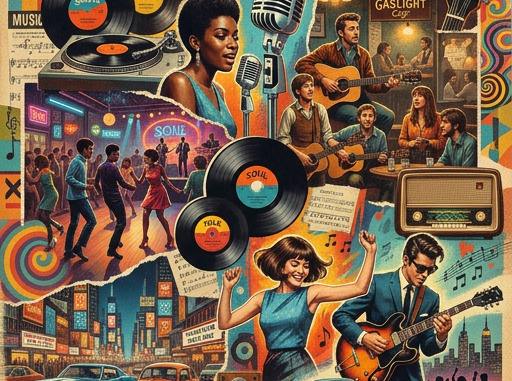
A Century of Song: The 1960s — Hour #3
As we venture further into the 1960s, the musical landscape becomes increasingly difficult to categorize. Pop, soul, blues, jazz, folk, and rock were no longer developing along entirely separate paths. They were borrowing from one another, challenging conventions, and occasionally producing something that defied easy description.
This hour embraces that diversity, moving from the irresistible rhythms of the Rascals and the emotional sophistication of the Marvelettes to the inventive musicianship of Thelonious Monk, Jimi Hendrix, Pink Floyd, and Traffic. Along the way, we encounter quieter moments of remarkable melodic beauty.
The result isn’t quite a greatest-hits collection, nor is it an excursion into obscurity for its own sake. It’s an attempt to capture a decade discovering just how many different directions popular music could take…without forgetting that the most important destination is still the listener’s enjoyment.
A Century of Song: The 1960s — Hour #3
| # | Song | Artist | Year |
|---|---|---|---|
| 1 | Come On Up | The Rascals | 1966 |
| 2 | The Hunter Gets Captured by the Game | The Marvelettes | 1967 |
| 3 | Up on the Roof | The Drifters | 1962 |
| 4 | I Can’t Quit Her | Blood, Sweat & Tears | 1968 |
| 5 | Picture Book | The Kinks | 1968 |
| 6 | The Way Young Lovers Do | Van Morrison | 1968 |
| 7 | Straight No Chaser | Thelonious Monk | 1967 |
| 8 | Born Under a Bad Sign | Cream | 1968 |
| 9 | Pretty Ballerina | The Left Banke | 1966 |
| 10 | Soul Kitchen | The Doors | 1967 |
| 11 | People Got to Be Free | The Rascals | 1968 |
| 12 | The Wind Cries Mary | The Jimi Hendrix Experience | 1967 |
| 13 | Lucifer Sam | Pink Floyd | 1967 |
| 14 | Never My Love | The Association | 1967 |
| 15 | Blackbird | The Beatles | 1968 |
| 16 | Dear Mr. Fantasy | Traffic | 1967 |
| 17 | Here Comes the Sun | The Beatles | 1969 |
1. Come On Up – The Rascals (1966)
The Young Rascals waste absolutely no time announcing their intentions on “Come On Up,” a blistering combination of blue-eyed soul, garage rock, and rhythm and blues that captures the group’s extraordinary energy. Driven by Felix Cavaliere’s ferocious Hammond organ, Dino Danelli’s explosive drumming, and Eddie Brigati’s exuberant vocals, the recording practically leaps out of the speakers.
Unlike the more polished pop productions dominating much of the mid-1960s, “Come On Up” thrives on its raw, almost reckless enthusiasm. The arrangement is tight but never restrained, with the organ and rhythm section pushing relentlessly forward while the vocals turn a simple invitation into an irresistible demand.
What makes the song particularly satisfying is its refusal to overcomplicate matters. There’s no elaborate lyrical message or studio experimentation, just four talented musicians demonstrating how electrifying a straightforward rock-and-soul performance can be.
It’s a wonderfully energetic way to open another hour of musical exploration.

2. The Hunter Gets Captured by the Game – The Marvelettes (1967)
By 1967, Motown was becoming increasingly adventurous, and the Marvelettes’ “The Hunter Gets Captured by the Game” demonstrates just how sophisticated the label’s sound could be. Written and produced by Smokey Robinson, this wonderfully atmospheric recording replaces the group’s earlier girl-group exuberance with something darker, subtler, and considerably more mysterious.
Wanda Young’s expressive lead vocal tells the story of a confident romantic pursuer who unexpectedly finds herself falling victim to the very game she believed she controlled. Beneath her performance, a slinky bass line, restrained percussion, and haunting instrumental flourishes create an atmosphere of playful intrigue.
What makes the recording so compelling is its remarkable economy. Nothing feels excessive, yet every musical detail contributes to its distinctive personality.
It’s a perfect example of Motown moving beyond its established formulas without abandoning the irresistible melodies and rhythmic sophistication that made those records so appealing. Sometimes the most effective musical revolutions arrive quietly, disguised as three-minute pop songs.

3. Up on the Roof – The Drifters (1962)
Sometimes the simplest pleasures provide the greatest escape, and few songs express that sentiment more beautifully than the Drifters’ “Up on the Roof.” Written by Gerry Goffin and Carole King, this elegant recording transforms an ordinary New York rooftop into a sanctuary above the noise, pressures, and frustrations of everyday life.
Rudy Lewis delivers a wonderfully relaxed lead vocal, supported by the group’s warm harmonies and an arrangement that combines gentle Latin-influenced rhythms, graceful strings, and an effortlessly memorable melody. The music itself seems to rise above the city, creating the same sense of peaceful detachment described in the lyrics.
What makes the song especially appealing is its modest ambition. There’s no grand romantic tragedy or sweeping social commentary, just the comforting realization that happiness can sometimes be found by changing one’s perspective…and climbing a few flights of stairs.
More than six decades later, “Up on the Roof” remains a beautiful reminder that musical sophistication and uncomplicated pleasure can coexist perfectly.
4. I Can’t Quit Her – Blood, Sweat & Tears (1968)
Before Blood, Sweat & Tears became synonymous with David Clayton-Thomas and their polished jazz-rock hits, the group was led by Al Kooper, whose ambitious musical vision helped bring together rock, blues, soul, and jazz. “I Can’t Quit Her,” from their debut album Child Is Father to the Man, captures that adventurous spirit without sacrificing the emotional directness of a great love song.
Kooper’s soulful, slightly ragged vocal conveys the frustration of a man who recognizes the destructive nature of his romantic attachment but remains powerless to escape it. Behind him, the band’s muscular horn arrangements, expressive keyboards, and driving rhythm section create a sound that feels both sophisticated and wonderfully spontaneous.
What’s particularly impressive is how naturally the various musical influences coexist. The horns aren’t merely decorative; they’re essential to the song’s dramatic momentum.
It’s an exhilarating early example of jazz-rock fusion, demonstrating that musical complexity could enhance the emotional impact of a song rather than overwhelm it.
5. Picture Book – The Kinks (1968)
Ray Davies had an extraordinary talent for finding humor, tenderness, and quiet melancholy in the seemingly ordinary details of British life. “Picture Book,” from the Kinks’ The Kinks Are the Village Green Preservation Society, turns the simple act of looking through old photographs into an irresistibly cheerful meditation on memory and the passage of time.
Built around a wonderfully playful guitar riff, buoyant rhythm, and the band’s charming vocal harmonies, the recording captures the peculiar pleasure of revisiting moments that seemed unremarkable when they occurred. Davies’ affectionate observations are tinged with gentle irony, suggesting that nostalgia can be both comforting and a little ridiculous.
What makes the song so appealing is its deceptively simple construction. The melody is infectious, the arrangement wonderfully uncluttered, and the performance radiates personality without demanding attention through elaborate production.
While much of rock music was becoming louder, heavier, and increasingly ambitious, the Kinks demonstrated that an ordinary family photo album could provide enough inspiration for a miniature pop masterpiece.
6. The Way Young Lovers Do – Van Morrison (1968)
Van Morrison’s Astral Weeks is celebrated for its dreamlike atmosphere and free-flowing musical arrangements, but “The Way Young Lovers Do” takes a decidedly different approach. Bursting with exuberance, this extraordinary recording combines jazz, soul, and folk influences into a compact explosion of rhythm and romantic excitement.
Morrison’s impassioned vocals weave through a bustling arrangement of horns, acoustic instruments, and an exceptionally nimble rhythm section. The musicians seem to be chasing one another through the melody, creating an exhilarating sense of spontaneity despite the intricate composition.
What makes the song particularly fascinating is its contrast with the rest of Astral Weeks. Where much of the album unfolds through lengthy, introspective passages, this track compresses an astonishing amount of musical activity into barely three minutes.
It’s a wonderful demonstration of Morrison’s ability to blur musical boundaries without losing emotional immediacy. Chaotic on the surface but remarkably cohesive underneath, “The Way Young Lovers Do” captures the breathless excitement of youthful romance with infectious musical imagination.

7. Straight, No Chaser – Thelonious Monk (1967)
Thelonious Monk had a remarkable ability to make a piano sound as though it were questioning everything the other musicians were doing. His unconventional phrasing, unexpected pauses, and angular melodies challenged traditional notions of jazz piano, yet beneath the apparent eccentricity lay an extraordinary sense of rhythm and musical invention.
“Straight, No Chaser” is built around a deceptively simple twelve-bar blues, but Monk transforms that familiar foundation into a delightful exercise in rhythmic surprise. Notes arrive where they aren’t expected, familiar phrases take peculiar detours, and the performance maintains a playful tension between structure and spontaneity.
What makes Monk especially rewarding is that his music doesn’t demand technical expertise to appreciate. His distinctive personality comes through in every phrase, and the blues foundation provides an accessible anchor for his more adventurous ideas.
It’s a wonderful reminder that musical sophistication needn’t come wrapped in solemnity. Sometimes genius sounds like someone having a tremendous amount of fun bending the rules.
8. Born Under a Bad Sign – Cream (1968)
Few songs demonstrate the enduring power of the blues quite as convincingly as Cream’s interpretation of “Born Under a Bad Sign.” Originally recorded by Albert King in 1967, this Booker T. Jones and William Bell composition receives a muscular British blues-rock treatment that preserves the original’s irresistible groove while adding considerable instrumental firepower.
Jack Bruce’s commanding bass and soulful lead vocal anchor the performance, while Eric Clapton’s biting guitar phrases provide a running commentary on the singer’s apparently lifelong misfortunes. Ginger Baker’s muscular but controlled drumming completes a remarkably tight arrangement, demonstrating that Cream could be just as compelling in a concise studio recording as during their extended improvisations.
What makes the song particularly satisfying is its balance of blues authenticity and rock intensity. The musicians never allow their technical abilities to overwhelm the melody or rhythmic foundation.
It’s a reminder that sometimes the most effective musical innovation isn’t inventing something entirely new, but discovering just how much excitement can be extracted from an established tradition.
9. Pretty Ballerina – The Left Banke (1966)
Few songs capture the delicate intersection of romantic longing and musical sophistication as beautifully as the Left Banke’s “Pretty Ballerina.” Written by keyboardist Michael Brown, this exquisite example of baroque pop blends classical influences with the emotional immediacy of a great 1960s love song.
The recording opens with a graceful, waltz-like piano figure that immediately establishes its dreamlike atmosphere. Steve Martin Caro’s wistful lead vocal conveys the fascination of someone captivated by an almost unattainable figure, while the restrained orchestration and gently unfolding melody create an atmosphere of tenderness and uncertainty.
What makes “Pretty Ballerina” particularly remarkable is its refusal to follow the prevailing rock and roll formula. The unusual rhythmic structure and classical embellishments give the song an elegance that feels almost timeless, yet its romantic vulnerability remains thoroughly accessible.
At a time when popular music was expanding in increasingly dramatic directions, the Left Banke demonstrated that innovation could also be quiet, graceful, and deeply affecting.
10. Soul Kitchen – The Doors (1967)
The Doors had an extraordinary ability to make even their most accessible songs sound faintly dangerous. “Soul Kitchen,” from their groundbreaking debut album, combines bluesy rock instrumentation, hypnotic rhythms, and Jim Morrison’s commanding vocals into a wonderfully atmospheric portrait of nighttime Los Angeles.
Inspired by Olivia’s, a soul-food restaurant Morrison frequented in Venice, California, the song transforms an ordinary neighborhood gathering place into something mysterious and almost mythical. Ray Manzarek’s swirling organ provides much of the recording’s distinctive character, while Robby Krieger’s sharp guitar accents and John Densmore’s restless drumming create a compelling rhythmic tension.
What makes “Soul Kitchen” particularly appealing is its balance of accessibility and strangeness. The melody is memorable, the groove irresistible, yet Morrison’s imagery suggests a world of desire, alienation, and restless nocturnal wandering.
It’s an early demonstration of the Doors’ remarkable chemistry, capturing the moment when familiar blues and rock ingredients began producing something altogether more unsettling and original.
11. People Got to Be Free – The Rascals (1968)
By 1968, the Rascals had moved well beyond the exuberant blue-eyed soul of their earlier hits, embracing a broader musical vision that reflected the social turbulence of the times. “People Got to Be Free” transforms a heartfelt plea for racial equality, tolerance, and human dignity into one of the decade’s most uplifting recordings.
Written by Felix Cavaliere and Eddie Brigati, the song combines gospel-inspired vocals, exuberant brass arrangements, and an irresistible rhythm that makes its message feel celebratory rather than confrontational. Cavaliere’s impassioned delivery and the group’s spirited harmonies give the performance an infectious sense of optimism.
What makes the recording particularly effective is its conviction that freedom and mutual respect should be universal rather than conditional. Its musical exuberance never diminishes the seriousness of that message.
Released during a year marked by extraordinary political and social upheaval, “People Got to Be Free” offers something increasingly rare amid the turmoil: an expression of hope that sounds entirely sincere.
12. The Wind Cries Mary – The Jimi Hendrix Experience (1967)
Jimi Hendrix is generally remembered for his explosive guitar playing and groundbreaking use of distortion and feedback, but “The Wind Cries Mary” reveals an equally remarkable gift for subtlety. This beautifully restrained recording replaces the customary psychedelic fireworks with a soulful, blues-inflected meditation on romantic disappointment and emotional isolation.
Hendrix’s warm, expressive guitar phrases seem almost conversational, answering his vocals with delicate melodic flourishes that demonstrate how much feeling he could communicate without overwhelming the arrangement. Mitch Mitchell’s understated drumming and Noel Redding’s supportive bass provide a spacious foundation, allowing every instrument to breathe.
What makes the recording extraordinary is its emotional intimacy. Hendrix wasn’t merely a revolutionary guitarist capable of astonishing technical displays. He was also a sensitive songwriter who understood that sometimes the quietest musical gestures could leave the deepest impression.

13. Lucifer Sam – Pink Floyd (1967)
Before Pink Floyd became synonymous with elaborate concept albums and sprawling progressive rock, they were exploring a considerably stranger musical universe under the leadership of Syd Barrett. “Lucifer Sam,” from their debut album The Piper at the Gates of Dawn, is a wonderfully eccentric example of British psychedelia, built around a sinister, spy-movie-style guitar riff and a mysterious feline protagonist.
The titular character was inspired by Barrett’s Siamese cat, although the lyrics suggest something considerably more unsettling than an ordinary household pet. Roger Waters’ insistent bass, Nick Mason’s propulsive drumming, and Rick Wright’s atmospheric keyboards create a hypnotic backdrop for Barrett’s whimsical, slightly detached delivery.
What makes the recording so appealing is its combination of playful absurdity and genuine musical menace. The arrangement is tight, the melody memorable, and the atmosphere delightfully peculiar.
It’s a fascinating glimpse of Pink Floyd before their music became grander and more solemn…a band capable of making three minutes of psychedelic mischief sound like an adventure into another dimension.
14. Never My Love – The Association (1967)
Some songs achieve their emotional impact through grand gestures, while others succeed through an almost effortless sense of sincerity. The Association’s “Never My Love” belongs firmly in the latter category, wrapping a simple declaration of enduring devotion in one of the most elegant pop arrangements of the 1960s.
Written by brothers Don and Dick Addrisi, the song features the group’s exquisitely blended vocal harmonies, a warm, gently pulsing bass line, and delicate instrumental flourishes that lend the recording an unusually graceful atmosphere. The subtle shifts in harmony and the beautifully measured pacing give the melody a sophistication that never calls attention to itself.
What makes “Never My Love” especially appealing is its complete absence of cynicism. At a time when popular music was increasingly embracing rebellion, experimentation, and social commentary, the Association demonstrated that an uncomplicated expression of romantic commitment could still sound fresh and compelling.
15. Blackbird – The Beatles (1968)
Amid the sprawling stylistic experimentation of the Beatles’ White Album, “Blackbird” stands as a remarkable example of how much can be accomplished with almost nothing. Paul McCartney’s delicate acoustic guitar, gentle vocal, and the occasional sound of birdsong create an atmosphere of extraordinary intimacy, allowing the song’s beautiful melody to unfold without unnecessary embellishment.
Inspired partly by the American civil rights movement, McCartney used the image of a wounded bird learning to fly as a metaphor for overcoming oppression and discovering freedom. The lyrics are simple enough to invite personal interpretation, yet powerful enough to carry a broader message of hope and resilience.
Musically, the recording is deceptively intricate. McCartney’s fingerpicked guitar pattern, influenced by Bach, provides both rhythmic momentum and harmonic sophistication beneath the seemingly effortless performance.
“Blackbird” demonstrates that the Beatles’ greatest innovations weren’t always technological or psychedelic. Sometimes their most profound achievements came from knowing exactly how little a song needed.

16. Dear Mr. Fantasy – Traffic (1967)
Traffic’s “Dear Mr. Fantasy” offers a fascinating glimpse into the darker side of the psychedelic era, where musical escapism and emotional uncertainty frequently traveled together. Written by Steve Winwood, Jim Capaldi, and Chris Wood, the song addresses a mysterious entertainer whose ability to bring happiness to others conceals a profound sadness of his own.
Winwood’s soulful, impassioned vocals provide the emotional centerpiece, while his expressive guitar playing, the steady rhythm section, and the band’s atmospheric instrumentation create a hypnotic blend of blues, rock, and psychedelia. The arrangement gradually intensifies, giving the musicians room to stretch without losing the song’s melodic foundation.
What makes the recording especially compelling is its underlying contradiction: the entertainer is expected to provide joy even when he cannot find it himself.
“Dear Mr. Fantasy” captures that tension beautifully, offering a surprisingly introspective conclusion to our more adventurous musical excursions before the Beatles bring this hour to a gentler close.
17. Here Comes the Sun – The Beatles (1969)
After a decade of extraordinary musical innovation, social upheaval, and increasingly ambitious experimentation, George Harrison offers a wonderfully simple conclusion: the promise that brighter days are coming. “Here Comes the Sun,” from the Beatles’ Abbey Road, transforms the welcome arrival of spring into one of popular music’s most enduring expressions of optimism.
Harrison’s sparkling acoustic guitar establishes the song’s irresistible warmth, while delicate harmonies, subtle synthesizer textures, and beautifully arranged instrumentation gradually illuminate the recording. Beneath its seemingly effortless melody lies considerable musical sophistication, including unusual rhythmic shifts that lend the middle section an unexpected sense of movement.
Written during a welcome escape from the pressures surrounding the Beatles’ business affairs, the song radiates relief, renewal, and quiet gratitude.
It’s a fitting conclusion to our journey through another hour of the 1960s. After all the experimentation, emotional turbulence, and musical complexity, we’re reminded that sometimes the greatest achievement is simply making the listener feel good to be alive.
Leave a Reply